Sponge Iron
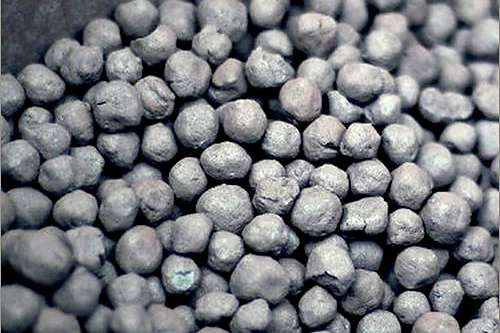
Direct reduced iron for the furnace charge.
Applications
As per Indian Standards
These are the Indian Standards Sponge Iron is commonly supplied to. Where one is quoted, the published standard governs, not our summary of it.
| Traded on | Chemistry, not an IS grade |
|---|---|
| Basis | Metallic iron content, degree of metallization, carbon |
| Form | Lump, fines or pellet, as agreed |
| Use | Charge for induction and electric arc furnaces |
| HSN | 72031000 |
| GST | 18% |
HSN codes are given for reference and are to be confirmed with the supplier before billing.
| Standard | What it covers | Where we use it |
|---|---|---|
| IS 15774 | Sponge iron and direct reduced iron, chemical composition by grade | Sponge iron |
Indian Standards are published by the Bureau of Indian Standards and are their property. They are named here so you can check a figure against the source, and quoted only as far as is needed to say what a number means. A material test certificate travels with the vehicle.
IS 15774:2007, Table 1, chemical composition of sponge iron and DRI, percent
| Constituent | Grade 1 | Grade 2 | Grade 3 |
|---|---|---|---|
| Total iron | 89 to 93 | 88, Min | 85 to under 88 |
| Metallic iron | 80, Min | 76, Min | 70, Min |
| Metallization | 88, Min | 86, Min | 82, Min |
| Carbon, coal based | 0.08 to 0.12 | 0.08 to 0.12 | 0.06 to 0.12 |
| Carbon, gas based | under 1.5 | under 1.5 | under 1.5 |
| Sulphur, coal based, Max | 0.030 | 0.030 | 0.030 |
| Sulphur, gas based, Max | 0.005 | 0.005 | 0.005 |
| Phosphorus, Max | 0.060 | 0.070 | 0.100 |
| Silica plus alumina, Max | 6 | 7 | 8 |
| Lead, zinc, copper, tin, chromium, nickel and arsenic together, Max | 0.010 | 0.015 | 0.015 |
Physical specification, clause 6.1 of the same standard. The size range of sponge iron lumps for steel making is 3 to 20 mm, with not more than 5 percent above 20 mm and not more than 5 percent below 3 mm. That range holds at the despatch end only — the standard says the size at the receiving point depends on transport and handling in transit. Up to 1 percent non-metallics may be present and are counted neither in the size distribution nor in the chemical analysis. Bulk density is 1.8 g/cc under clause 7. The standard also advises that sponge iron should not come into contact with water at any stage before use, because it reoxidises. Clause 9 requires the material to travel with a test certificate giving the grade, the chemical composition, the size specification and the maker. Note that BIS lists a 2018 revision of IS 15774, so confirm which edition your enquiry is written against.
IS 15774:2007, Table 1 and clauses 6.1, 7 and 9, via Public.Resource.Org